


The fastest way to lose an ad account, a certification, or a pharmacy partner is to tell customers what a peptide will do for their body. This guide covers what to avoid, what to say instead, and how to build a review process that keeps your marketing safe as the rules keep changing.
Why wording matters more than you think
Regulators don't judge your product by what you call it. They judge it by what you say it is for. Under the Federal Food, Drug, and Cosmetic Act, a product is treated as a drug when your marketing shows it is intended to diagnose, treat, cure, or prevent disease, or to affect how the body works. That evidence includes your website copy, ads, social posts, influencer scripts, and even what your team says in DMs.
Two points surprise most brands:
- Drugs have no "wellness claim" loophole. Saying a product "supports tissue repair" can be read as the same claim as "heals tissue."
- A disclaimer won't rescue a bad claim. The FTC looks at the overall impression of an ad. A fine-print line cannot undo a headline that promises results.
The regulatory picture right now
Peptide regulation is moving, and older guidance can be out of date. Here is where things stand as of November 2026.
- In April 2026, FDA announced that 12 peptides were coming off its Category 2 list of substances raising significant safety concerns. Removal did not by itself make them eligible for compounding.
- In July 2026, FDA's Pharmacy Compounding Advisory Committee recommended BPC-157, KPV, TB-500, MOTS-c, Epitalon, and Semax for the 503A Bulks List, and recommended against DSIP. Several votes were narrow, and FDA staff had recommended against inclusion.
- Those votes are advisory. Formal listing generally requires rulemaking. Legal commentary published on November 3 reports a separate HHS policy allowing compounding of the six ahead of that process. Ask your pharmacy partner and counsel exactly what it covers before relying on it.
What this means for your marketing: a favorable vote or policy is not FDA approval, and you should never imply that it is. Your pharmacy's compounding eligibility and your advertising claims are two separate questions.
What you cannot say
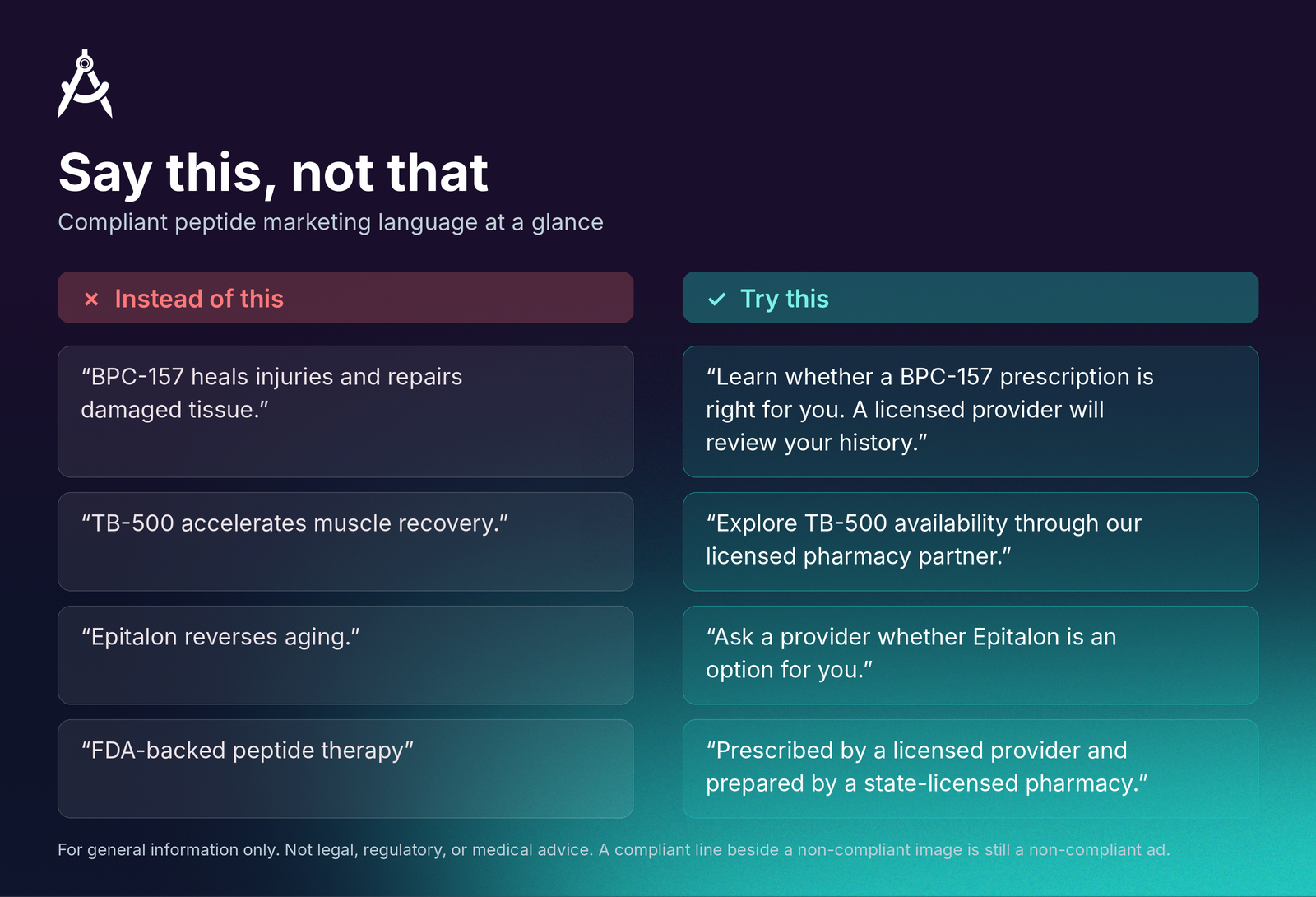
Avoid language that claims, or implies, that a peptide treats, cures, prevents, or changes a condition or a body process. Words to steer clear of include:
- Treats, cures, heals, prevents, reverses
- Repairs, regenerates, rebuilds, restores, eliminates
- Reduces inflammation, accelerates recovery
Also avoid:
- Calling a compounded product FDA-approved, FDA-backed, or clinically proven
- Calling your pharmacy "FDA-registered" or "FDA-approved" when it is a state-licensed 503A pharmacy
- Guaranteeing results or timelines
- Comparing a compounded product to a branded drug, or calling it a generic version
- Before-and-after photos and results-based testimonials
- Longevity, anti-aging, muscle growth, fat loss, or cognitive claims without human evidence behind them
What you can say instead
Talk about the service, the process, and the facts. Good examples:
- "Explore available peptide options."
- "Connect with a licensed healthcare provider."
- "Personalized care based on your individual needs."
- "Your wellness journey starts with an individual evaluation."
You can also describe the consultation steps, the dosage form, administration instructions from the pharmacy, eligibility requirements, pricing, and shipping, as long as each statement is accurate and documented.
The places claims hide
Most violations don't come from the headline. They come from the details teams forget to check:
- Page titles, meta descriptions, and URL slugs (for example, /bpc157-tendon-repair)
- Image file names and alt text
- Hashtags, handles, and paid search keywords
- Chatbot scripts and sales replies
- Comments you reply to, repost, or "like"
- Product and bundle names such as "Recovery Stack"
- Video thumbnails, voiceover, and on-screen text
- Blog posts that discuss research and then link straight to a product page
Influencers and affiliates
You are responsible for what the people you pay say about your products. Put these rules in every agreement:
- Written approval of scripts and final posts before they go live.
- A prohibited-claims list and a copy of your guidelines.
- A clear disclosure of the paid relationship in every post.
- No personal injury or disease stories, no dosing advice, and no sourcing advice outside your prescription process.
- Takedown within a set time after notice, with audit rights.
Do not reshare creator or customer content that makes claims you could not make yourself.
Don't forget the product page disclosure
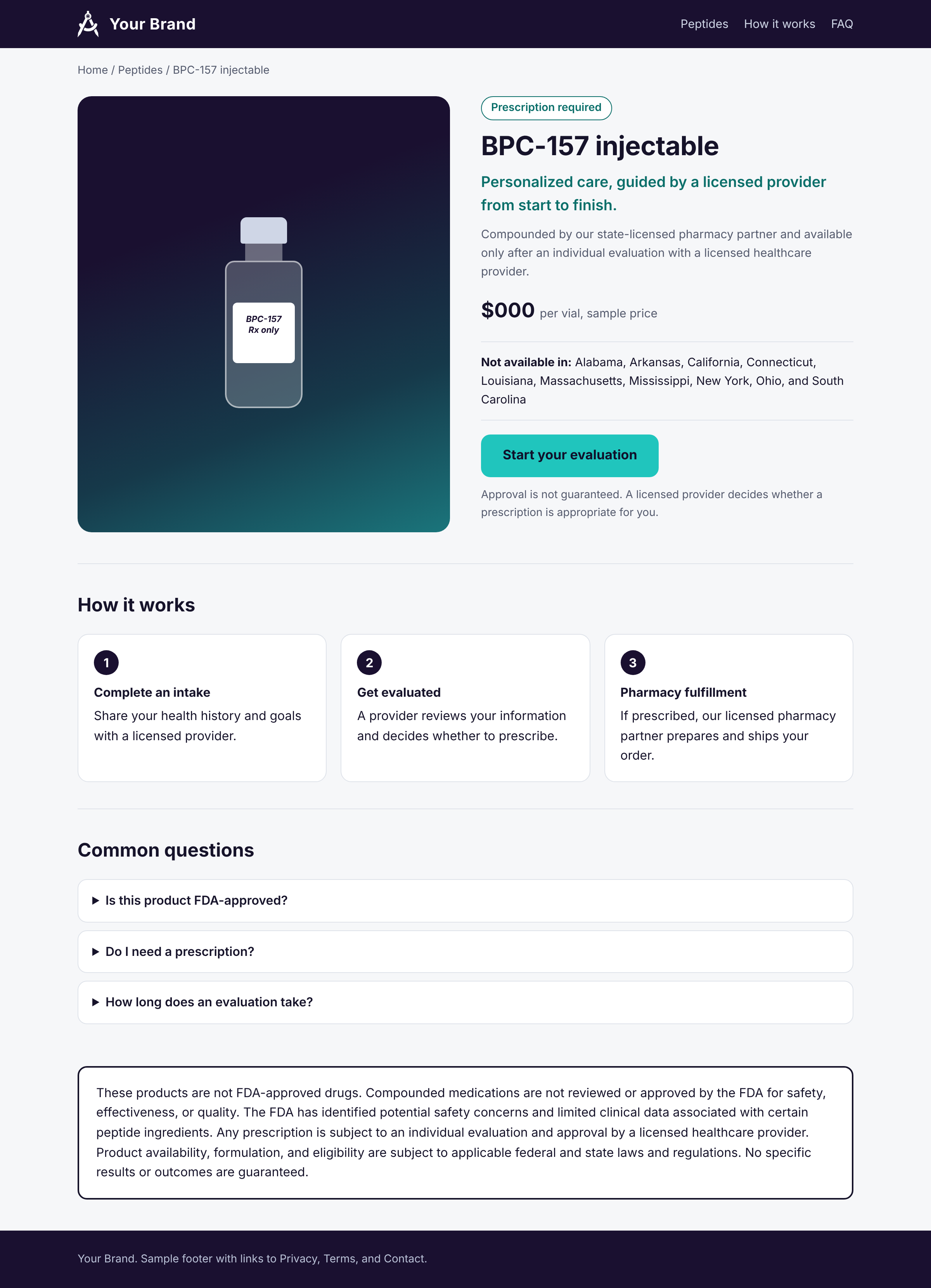
Every peptide product page needs the required disclosure about FDA status, compounded medication status, and prescription requirements. Place it near the bottom of the page, above the footer, as plain visible text. It should not sit behind a link, dropdown, or expandable section. Build it into your page template so it can't be lost when pages are copied. Remember that the disclosure supports your other content; it does not excuse a misleading claim.
Build a simple review process
A repeatable process protects you better than any one-time clean-up.
- Draft against your prohibited-claims list.
- Review text, images, metadata, and links.
- Check product details with your pharmacy and medical team.
- Escalate new claims, products, channels, or regulatory news to counsel.
- Log every approved claim with its date and reviewer.
- Monitor your site, social accounts, and affiliates on a schedule.
Re-open review whenever FDA or HHS acts on a peptide, your pharmacy or product changes, or a platform updates its policy.
Sample product page
Here are simple components to an effective landing page for peptides:
The bottom line...
When in doubt, leave the claim out. Focus on your licensed providers, your process, and accurate product facts, and re-check the regulatory status before every campaign.
This post is for general information only. It is not legal, regulatory, or medical advice, and following it does not guarantee compliance, certification, or platform approval. Consult qualified regulatory counsel and your dispensing pharmacy before publishing marketing materials.